 EN
EN

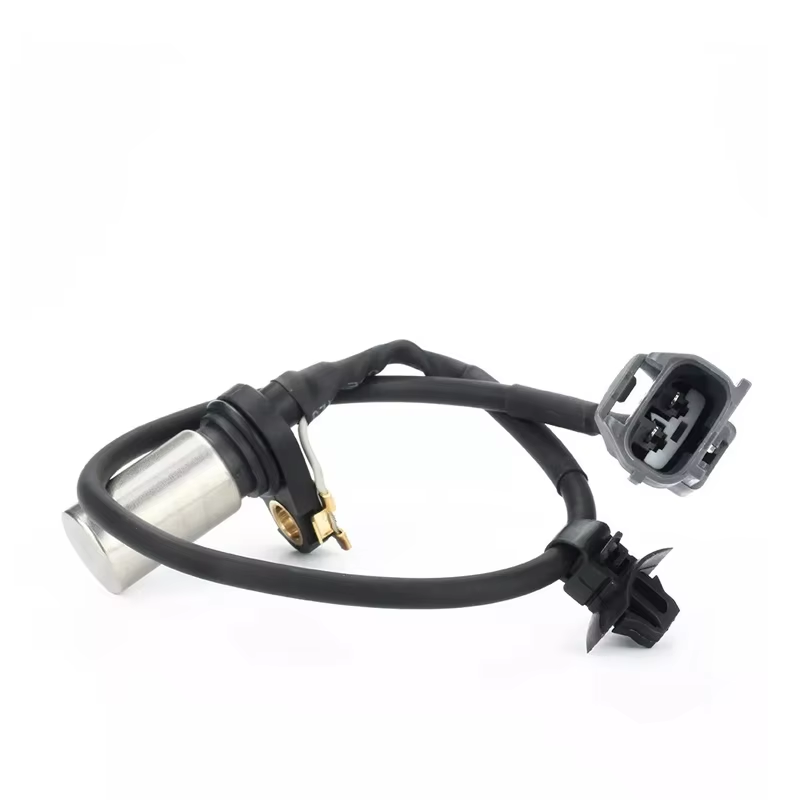
How the Crankshaft Position Sensor Works and Why It’s Critical
Principle: How the Crankshaft Position Sensor Monitors Rotational Speed and Position
Crankshaft sensors work by detecting those little notches on what's called a reluctor ring that sits right there on the crankshaft itself. As each notch goes past, it creates small voltage pulses. These sensors typically rely on either magnetic principles or Hall-effect technology to send all this information over to the Engine Control Unit, commonly known as ECU. What does this mean? Well, the ECU can figure out exactly how fast the engine is spinning, usually within about plus or minus 2 RPM according to some research from SAE in 2021. Plus, it knows where each piston is positioned down to roughly 0.1 degrees of crank angle. All this real-time info keeps the combustion timing spot on, even when engines rev way past 6,000 RPM. For car manufacturers trying to balance power output with fuel economy, having such accurate feedback makes a huge difference in their design choices.
The Role of the Crankshaft Sensor in Modern Engine Management Systems
Today's engine control units handle crankshaft sensor information at a rate of around 300 readings every single second. This allows them to manage when sparks fire, how long fuel injectors stay open, and even adjust valve timing as needed. According to research from Bosch engineers last year, any delay beyond 50 microseconds in processing these signals cuts down on combustion efficiency somewhere between 8% and 12%. What does that mean? More unburned fuel ends up as harmful hydrocarbons in exhaust gases. Being the main source for timing information, this particular sensor makes possible those smart control systems that keep engines running smoothly no matter what kind of driving conditions they face day after day.
Evolution from Mechanical to Digital Timing Control via Crankshaft Sensor Data
Prior to the 1980s, most cars relied on mechanical distributors to handle ignition timing, but these components had a problem with wear over time causing timing drift of around plus or minus 5 degrees. When automotive manufacturers started switching to digital systems equipped with crankshaft position sensors, they saw a dramatic improvement in timing accuracy down to less than 0.1 degree. This made combustion much more consistent across different driving conditions. A recent EPA analysis from 2022 showed that this technological leap cut nitrogen oxide emissions by about 32 percent in gas-powered vehicles. Plus, it allowed engine control units to make instant adjustments based on factors like elevation changes, ambient temperatures, and even variations in fuel composition without needing driver input.
Optimizing Sensor Placement for Maximum Signal Accuracy
| Placement Factor | Ideal Specification | Error Consequences |
|---|---|---|
| Air Gap Distance | 0.5–1.2 mm | Signal dropout above 2,000 RPM |
| Angular Alignment | ±1° relative to reluctor | Timing calculation errors |
| Environmental Protection | IP67-rated housing | Corrosion-induced signal noise |
Improper placement leads to synchronization failures, contributing to $2.1 billion annually in towing and diagnostics costs (NHTSA 2023). Technicians use laser alignment tools during replacement to ensure OEM-specified tolerances are met, preserving signal integrity.
Crankshaft Sensor’s Role in Ignition and Fuel Injection Timing
Synchronization of Spark and Fuel Delivery Using Crankshaft Sensor Signals
The crankshaft sensor works kind of like a metronome for the engine, constantly sending information about how fast it's spinning and where those pistons are at any given moment. When it detects those little teeth on what's called a reluctor ring, it tells the spark plugs when to go off, usually within just 1 to 2 degrees of perfect timing. At the same time, it also sends signals to open up the fuel injectors right before those intake valves start moving. If something goes wrong with this sensor, most modern engines simply won't run properly because they rely so heavily on these signals for both starting up and keeping everything running smoothly. Industry studies back this up too, according to Counterman who looked into fuel systems last year.
How Crankshaft Sensor Signals Influence ECU Decisions on Timing
The engine control unit gives top priority to crankshaft position readings when figuring out ignition timing and fuel injection durations. If there's even a 10% mistake in where the crank is positioned, this can push back the spark timing anywhere from 3 to 5 degrees. That small error ends up cutting combustion efficiency down by as much as 12%, especially noticeable in turbocharged engines. Camshaft sensors do play a part in determining which cylinders fire when, but whenever there's a conflict between sensor readings, the ECU always goes back to what the crankshaft tells it. This shows just how important accurate crankshaft information is for keeping everything timed right on those pistons moving up and down inside the block.
Case Study: Misfire Reduction in Turbocharged Engines Through Precision Sensor Feedback
A 2023 study of direct-injection turbo engines showed that high-resolution crankshaft sensors reduced misfires by 37% under high boost. Their ability to detect minute variations in crankshaft acceleration allowed earlier knock detection and dynamic ignition adjustments, improving combustion stability during aggressive load changes.
Adoption of Dual-Pulse Sensors for Enhanced Timing Resolution
To meet demands at high RPM, modern engines increasingly adopt dual-pulse crankshaft sensors that combine low- and high-frequency signals. This design achieves timing resolution below 0.1 degrees—essential for engines operating beyond 7,000 RPM. Manufacturers report 15–20% gains in transient response after implementation, as detailed in precision timing control research.
Engine Control Unit Dependence on Crankshaft Sensor Data
Modern engines depend on the crankshaft sensor as the foundational source for combustion control, fuel management, and emissions regulation. Its uninterrupted data stream ensures reliable engine operation across diverse driving conditions.
ECU Reliance on Crankshaft Sensor for Core Engine Functions
The ECU uses crankshaft sensor signals to determine ignition timing per cylinder, calculate fuel injection duration, and manage engine speed inputs for traction control and transmission shifts. Without this information, the ECU cannot maintain stoichiometric air-fuel ratios or prevent sustained misfires, leading to operational failure.
Data Flow from Crankshaft Sensor to ECU in Closed-Loop Control Systems
In closed-loop systems, the ECU cross-references crankshaft data against preloaded timing maps up to 4,000 times per second. Detected deviations prompt immediate corrections:
| Parameter | Adjustment Range | Response Time |
|---|---|---|
| Ignition timing | ±15° BTDC | <10 ms |
| Fuel pulse width | ±3.2 ms | <15 ms |
This rapid adjustment prevents detonation under load and maintains compliance during sudden throttle changes.
Case Study: ECU Limp Mode Activation in Ford EcoBoost Engines Due to Sensor Failure
Analysis of 1,200 Ford EcoBoost engines revealed that 63% of limp mode events originated from degraded crankshaft sensor signals. When sensor accuracy fell below 92%, the ECU defaulted to a conservative fixed timing (5°–10° retarded), cutting power output by 22–31% to avoid mechanical damage, as documented in diagnostic analyses of crank sensor failures.
Enhancing Fault Detection Algorithms Within the ECU
Next-generation ECUs use machine learning to differentiate true sensor faults from electromagnetic interference. By cross-referencing data from camshaft sensors, knock sensors, and turbocharger speed inputs, these systems reduce false error codes by 41% and accelerate fault identification by 18 milliseconds compared to legacy approaches.
Symptoms, Diagnosis, and Consequences of a Failing Crankshaft Sensor
Common Symptoms: Check Engine Light, Rough Idling, and No-Start Conditions
When a crankshaft sensor starts going bad, it usually sets off those annoying intermittent check engine warnings, then causes the engine to idle roughly with RPMs bouncing around between 300 and 500. What's happening under the hood? The engine control unit can't trust its timing calculations anymore, so misfires start occurring. Things get really serious when the sensor sends messed up position information to the computer. This keeps the fuel injectors from firing properly when trying to start the car, sometimes leaving drivers stranded completely. Mechanics see this pattern all the time too - according to industry stats, nearly 4 out of every 10 breakdowns linked to faulty sensors show up just minutes after someone first notices rough idling.
Diagnostic Tools and Techniques for Identifying Crankshaft Sensor Malfunctions
Technicians follow a structured diagnostic approach:
- Code Analysis: OBD-II scanners retrieve P0335–P0339 fault codes linked to circuit or signal issues
- Signal Validation: Oscilloscopes assess waveform shape, frequency, and amplitude against OEM specifications
- Bench Testing: Resistance checks (typically 500–1,500Ω) performed across temperature ranges to verify internal coil integrity
For infrared or digital sensors, alignment within 0.5 mm of the trigger wheel is crucial to prevent intermittent signal loss.
OEM vs. Aftermarket Sensor Performance and Reliability
| Metric | OEM Sensors | Aftermarket Sensors |
|---|---|---|
| Signal Consistency | 99.1% over 10k cycles | 87.4% over 10k cycles |
| Operating Temp Range | -40°F to 302°F (-40°C to 150°C) | -22°F to 257°F (-30°C to 125°C) |
| Mean Time Between Failures | 72,000 miles | 34,000 miles |
OEM sensors feature hardened epoxy encapsulation that reduces moisture-related failures by 63% compared to many aftermarket alternatives, ensuring long-term reliability in harsh environments.
Short-Term and Long-Term Risks of Operating with a Faulty Crankshaft Sensor
Immediate Impacts
- 9–14% drop in fuel economy
- 50% rise in NOx emissions
- Accelerated spark plug wear due to retarded timing
Extended Operation
- Crankshaft bearing damage from fuel-diluted oil (up to 22% viscosity loss)
- ECU forced into open-loop mode, doubling particulate emissions
- 78% likelihood of secondary component failure within 1,000 miles
Potential for Catalytic Converter Damage and Rising Repair Costs
Persistent misfires send unburned hydrocarbons into the exhaust, overheating catalytic converters. Laboratory tests show substrate temperatures exceeding 1,472°F (800°C) for more than 15 minutes cause irreversible ceramic collapse. Total repair costs average $1,880, including sensor replacement ($145–$410) and catalytic converter replacement ($1,200–$2,200). In 42% of turbocharged models, additional exhaust manifold repairs are required.
How Crankshaft Sensor Accuracy Affects Fuel Efficiency, Emissions, and Drivability
Small Timing Errors Leading to Significant Fuel Economy Losses
Even minor inaccuracies—less than 0.5-degree deviation—can degrade fuel efficiency. Industry research shows faulty sensors increase fuel consumption by 2.8% in turbocharged engines. Since injector pulse width relies directly on crankshaft speed data, timing errors disrupt stoichiometric combustion, forcing the ECU to compensate with suboptimal fueling strategies.
Link Between Sensor Precision and Optimal Air-Fuel Ratio Control
Getting the crankshaft position just right helps maintain about 0.25% accuracy for air fuel ratios when the system is running in closed-loop mode. When there's a delay or inconsistency in these signals, it causes misfires. This lets unburned fuel slip past the catalytic converter, which can push hydrocarbon levels all the way up to 1,200 parts per million. That's way above the EPA standard of under 100 ppm by a long shot. Most engine control units will actually compensate for this problem by making the fuel mixture richer than normal. But this fix comes at a cost, typically costing drivers between 3 and 5 miles per gallon in fuel efficiency.
Case Study: Emission Test Results Before and After Sensor Replacement in a Toyota Camry
A 2023 evaluation of a Camry with a failing crankshaft sensor demonstrated dramatic improvements post-replacement:
| Metric | Before Replacement | After Replacement | Improvement |
|---|---|---|---|
| NOx Emissions | 0.12 g/mile | 0.04 g/mile | 66% |
| Fuel Efficiency | 28.1 MPG | 32.6 MPG | 16% |
| Cold Starts | 4.2 seconds | 2.1 seconds | 50% |
Improved ECU responsiveness shortened catalytic converter light-off time, reducing cold-start emissions by 41%, highlighting the sensor's impact on both performance and environmental compliance.
FAQ
What is a crankshaft position sensor?
A crankshaft position sensor monitors the rotational speed and position of the crankshaft in an engine, providing data for combustion timing and fuel delivery.
How does the crankshaft sensor affect my car's performance?
The sensor provides critical timing information for ignition and fuel injection, influencing engine efficiency, emissions, and overall drivability.
What are the signs of a failing crankshaft sensor?
Common symptoms include the check engine light, rough idling, and no-start conditions. Misfires and timing errors are also indicators.
What are the costs associated with crankshaft sensor malfunction?
Repair costs can include sensor replacement ($145–$410), catalytic converter replacement ($1,200–$2,200), and potential exhaust manifold repairs.
Table of Contents
- How the Crankshaft Position Sensor Works and Why It’s Critical
- Crankshaft Sensor’s Role in Ignition and Fuel Injection Timing
- Engine Control Unit Dependence on Crankshaft Sensor Data
- Symptoms, Diagnosis, and Consequences of a Failing Crankshaft Sensor
- Common Symptoms: Check Engine Light, Rough Idling, and No-Start Conditions
- Diagnostic Tools and Techniques for Identifying Crankshaft Sensor Malfunctions
- OEM vs. Aftermarket Sensor Performance and Reliability
- Short-Term and Long-Term Risks of Operating with a Faulty Crankshaft Sensor
- Potential for Catalytic Converter Damage and Rising Repair Costs
- How Crankshaft Sensor Accuracy Affects Fuel Efficiency, Emissions, and Drivability
- FAQ